Plan eligibility
Availability depends on your Anthropic plan. As of 2026-05-12, the official help center article (Anthropic article 11932705) explicitly lists three compatible plans.
| Plan | /security-review (CLI) | GitHub Action |
|---|---|---|
| Pro (individual) | Yes | Yes via API key |
| Max (individual) | Yes | Yes via API key |
| API Console (pay-as-you-go) | Yes | Yes |
| Free plan | Not listed as eligible | No |
| Team / Enterprise | Not specified in the help center as of 2026-05-12 | Confirm with support |
On the CI side, the GitHub Action needs a valid Claude API key stored as a repo secret. In practice that means an active API Console credit balance or a compatible plan that exposes a key usable outside the CLI.
Why /security-review matters
Anthropic's pitch is straightforward in the product blog post from 2025-08-06: turn a security review into a few-seconds gesture, baked into the coding workflow. Where a static scanner like Semgrep or Snyk applies a rule catalog (often calibrated against the OWASP Top 10), this AI security scanner leans on the model's reasoning to analyze code in context. The GitHub Action's README claims "deep semantic analysis" and "advanced false positive filtering", two promises you won't find in signature-based tools.
Three practical differences from a classic scanner:
- The command reasons about the current diff. It sees the modified function and its callers, not just the flagged line.
- It's language-agnostic. The Action's README spells out "language-agnostic", which saves you from installing a dedicated parser per stack.
- It suggests a fix you can apply. Once a finding shows up, you can ask Claude to apply the patch right away, no manual copy-paste.
The flip side holds too: /security-review does not replace a static scanner. Anthropic's docs are firm on the word "complement", not "replace". More on that in the limits section.
Running the command locally
Start a Claude Code session
Open your terminal at the project root and run claude. If you hit unexpected behavior, check your version with claude --version. The command shipped on 2025-08-06.
cd ~/projects/my-appclaude
Modify code without committing
The command analyzes your current diff. As long as you haven't committed, edit files as usual. For a first dry run, introduce an obvious flaw: a concatenated SQL query or a hardcoded secret.
Run the command
In the active Claude Code session, type the command with no arguments.
/security-review
Claude then orchestrates several internal agents: one identifies the vulnerabilities in the diff, then secondary agents filter false positives per category (SQL injection, hardcoded API key, etc.). This "FP filter" mechanic is documented as a strength of the native command, and shows up directly in the console output.
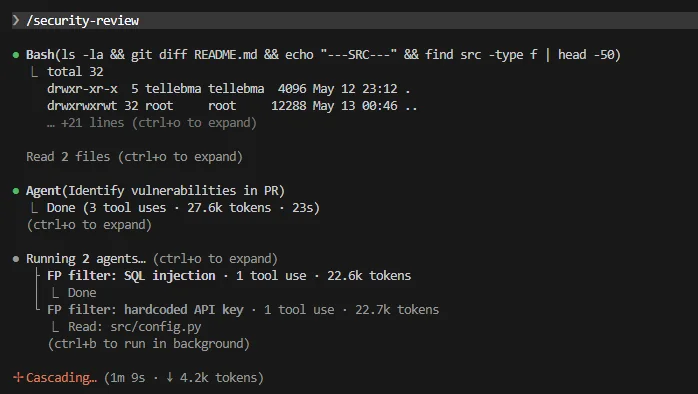
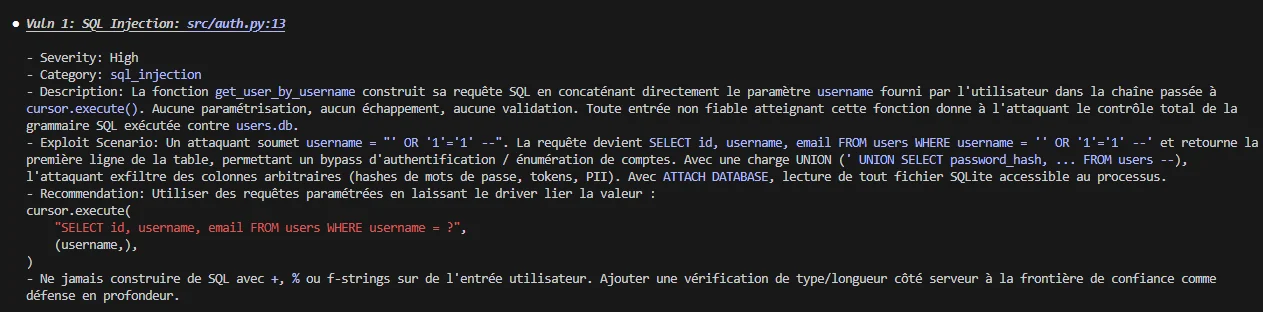
Once the agents are done, Claude prints findings ranked by severity. Each one has a description, a location, an exploit scenario, and a concrete recommendation.
Ask for a fix
If a finding looks legit, ask Claude to apply the patch on the spot. A simple "apply the fix for finding 1" is enough. The model rewrites the affected block, and you review the diff like any other file edit.
Re-scan before committing
Once corrections land, run /security-review again to confirm no findings remain. This "scan, fix, re-scan" loop wraps up in a few minutes on a medium-sized diff.
The primary help center source does not document any flag or argument for the command as of 2026-05-12. If Anthropic adds options later, /security-review --help inside the CLI should surface them.
Automating with the GitHub Action
The CI counterpart is the open-source repo anthropics/claude-code-security-review (ouvre un nouvel onglet), published under the MIT license. As of 2026-05-12, it sits at 4,573 stars, 432 forks and 69 open issues, latest push on February 11, 2026. The job fires on every pull request and posts findings inline as PR comments.
Minimal workflow
Here's the exact snippet the README ships with. It's fifteen lines long, scans the PR diff, and posts findings as comments.
name: Security Reviewpermissions:pull-requests: write # Needed for leaving PR commentscontents: readon:pull_request:jobs:security:runs-on: ubuntu-lateststeps:- uses: actions/checkout@v4with:ref: ${{ github.event.pull_request.head.sha || github.sha }}fetch-depth: 2- uses: anthropics/claude-code-security-review@mainwith:comment-pr: trueclaude-api-key: ${{ secrets.CLAUDE_API_KEY }}
Two things to nail down during setup:
CLAUDE_API_KEYsecret: create it underSettings → Secrets and variables → Actions. The key needs access to both the Claude API and Claude Code.- GITHUB_TOKEN permissions:
pull-requests: writeto post comments,contents: readto read the code. Nothing more.
Configuration options
The main options exposed by the Action are documented in the README as of 2026-05-12.
| Option | Default | Purpose |
|---|---|---|
claude-api-key (required) | none | API key with access to the Claude API and Claude Code |
comment-pr | true | Post findings as PR comments |
claude-model | claude-opus-4-1-20250805 | Model used for analysis |
claudecode-timeout | 20 minutes | Maximum analysis timeout |
exclude-directories | none | Folders excluded from the scan (test fixtures, etc.) |
The Action is diff-aware: it only analyzes files modified by the PR, not the whole repo. This avoids the cost blowup you'd hit on any project past a few thousand lines.
The 5 official families detected
Anthropic's help center formalizes five vulnerability families. The Action's README lists more granular technical subtypes. The two lists don't contradict each other, the second is just finer-grained.
| Official family (Anthropic help center) | Concrete subtypes listed in the Action's README |
|---|---|
| SQL injection risks | SQL injection, command injection, LDAP, XPath, NoSQL, XXE |
| Cross-site scripting (XSS) | Reflected XSS, stored XSS, DOM-based XSS |
| Authentication and authorization flaws | Broken auth, privilege escalation, IDOR, bypass logic, session flaws |
| Insecure data handling | Hardcoded secrets, sensitive data logging, information disclosure, PII violations |
| Dependency vulnerabilities | Vulnerable packages, typosquatting risks |
This five-family layout works as a reading grid. In practice you'll also see findings around weak crypto or insecure default configurations: Anthropic maps these under "insecure data handling" or "dependency vulnerabilities" depending on the case.
Limits and false positives
Four more limits to keep in mind:
- Code is sent to the Anthropic API. Every call ships your diff to Anthropic's servers. For proprietary or NDA-bound code, vet your org's data policy and Anthropic's first.
- Token cost. The command bills like any other API call. On a busy repo (dozens of PRs per day), watch consumption, especially if you wire the Action to every push.
- Categories filtered out by default. To cut noise, the Action excludes Denial of Service, rate limiting, memory/CPU exhaustion, input validation without proven impact, and open redirects. If those angles matter to you, tweak the custom instructions.
- No coverage guarantee. Anthropic says it plainly in the help center: "While automated security reviews help identify many common vulnerabilities, they should complement, not replace, your existing security practices." No precision or recall numbers are published.
Wiring the command into a DevSecOps workflow
/security-review shines when it sits inside a toolchain, not alone. Here's a defensive combo you'll often see on mature projects, paired with the security best practices page and the CI/CD and cybersecurity guide.
| Tool | Role | Complements /security-review by |
|---|---|---|
| gitleaks | Detect secrets committed to git history | Catching historical leaks the command can't see (it only reads the PR diff) |
| dependabot | Vulnerable dependency updates | Handling the "dependency vulnerabilities" family upstream, freeing /security-review to focus on application code |
| CODEOWNERS | Targeted human review by path | Forcing a human to validate findings on sensitive paths (auth, payments) |
| Branch protection | Required status checks before merge | Letting the GHA job become a blocking status if you want to gate merges |
On the CLI side, you can also trigger the command automatically through a Claude Code PreToolUse hook on git commit. The mechanism is covered on the hooks page and stops you from forgetting the review before a push.
If an API key did leak through the cracks, the remediation playbook lives in Leaked API key recovery. To harden the MCP servers Claude calls during the review, see MCP security. For community agents dedicated to audit work (Security Reviewer, TDD Guide), the curated list is on Best security plugins.
On the threat model side, remember /security-review does not replace a manual pentest or a commercial SAST tuned to your stack. It catches a meaningful share of recurring mistakes (concatenated SQL, forgotten secrets, missing access controls) before they hit prod, which is already valuable.
Don't confuse it with the everything-claude-code:security-review skill
The Claude Code ecosystem hosts a community skill of the same name in the everything-claude-code (ouvre un nouvel onglet) plugin (180k+ GitHub stars, verified 2026-05-13). When that plugin is installed, the /security-review autocomplete shows both entries side by side. They are not the same beast. For more on the plugin itself and the skills it bundles, see our Awesome Skills catalog and the skills comparison.
| Criterion | /security-review native Anthropic | /everything-claude-code:security-review (plugin skill) |
|---|---|---|
| Type | Native slash command baked into the CLI | Markdown skill loaded into Claude's context |
| Mechanic | Multi-agent architecture: one agent identifies vulnerabilities, "FP filter" agents filter false positives per category | Loads a static OWASP checklist into the prompt, asks Claude to apply it |
| Diff analyzed | Uncommitted working tree | git log origin/HEAD... (fails without an origin remote) |
| Output | Structured findings (severity, category, exploit scenario, recommendation) | Free-form text driven by Claude's general prompting |
| Coverage | 5 official families + sub-types (SQL, XSS, auth, validation, dependencies) | 10 extended OWASP categories (secrets, validation, SQL, auth, XSS, CSRF, rate limiting, exposure, Solana blockchain, dependencies) |
| Dependencies | None (built into the CLI) | Prior install of the everything-claude-code plugin |
| Eligible plans | Pro, Max, API Console pay-as-you-go | Any (no Anthropic-side restriction, it's just a markdown skill) |
| Updates | Handled by Anthropic | Versioned in the affaan-m/everything-claude-code repo |
In practice: if you have access to the native command (compatible plan), use the native one, it was designed for the job. If you are on the Free plan or want a forkable community workflow, the plugin skill is a valid option, but it's a different object, an enriched prompt rather than a dedicated command.
In autocomplete: type /security-review, press ↓ to see both the no-prefix entry (native) and the everything-claude-code: entry (skill). Pick the one that matches what you want to do.
Going further
Beyond the slash command, Anthropic ships a web product called "Claude Code Security". It's an Enterprise offering for continuous scanning of a full codebase, with a dashboard and grouped patch suggestions. As of 2026-05-12, this product is distinct from /security-review: the slash command stays available to all paid individual plans, the web product targets Enterprise teams. If you landed here looking for the web product, check Anthropic's official docs rather than this article.
Official links worth bookmarking :
- Automated security reviews in Claude Code (ouvre un nouvel onglet) (help center, primary source)
- Automate security reviews with Claude Code (ouvre un nouvel onglet) (product announcement, 2025-08-06)
- anthropics/claude-code-security-review (ouvre un nouvel onglet) (Action repo, MIT)
Next steps
- Run
/security-reviewlocally in your next Claude Code session, on a real diff - Wire the GitHub Action into a secondary repo to calibrate cost and finding relevance before enforcing it in CI on critical repos
- Read the hooks page to automate the command before each commit
- Round out your defense with the practices laid out in security best practices and CI/CD and cybersecurity